Most Americans have never seen a truly dark sky. Over 80% of the US population lives under light-polluted skies, and for many, the Milky Way is something they've only seen in photographs. Idaho is one of the last states where that isn't true.
Why Idaho for Stargazing
Idaho ranks among the darkest states in the continental US, and it isn't close. The combination of low population density, vast tracts of public land, and high-desert elevation creates conditions that are genuinely difficult to find elsewhere. The entire central spine of the state — from the Sawtooth Range down through the Snake River Plain — sits at elevations between 3,500 and 7,000 feet, above much of the atmospheric moisture that dims stars at lower altitudes.
The state has no city larger than 250,000 people. Boise, the capital and largest metro, is compact by western standards and its light dome fades quickly once you drive 30 minutes in any direction. South of the Snake River, vast stretches of high desert and agricultural land produce almost no artificial light at all.
If you pull up a dark sky Idaho map — like the one maintained by Light Pollution Map or the International Dark-Sky Association — the state lights up (or rather, doesn't) in ways that make it immediately obvious why astronomers and astrophotographers make pilgrimages here. Entire counties register as Bortle Class 1 or 2, which means skies dark enough to see the zodiacal light, the gegenschein, and structure in the Milky Way visible to the naked eye.
Understanding the Bortle Scale
The Bortle scale runs from 1 (the darkest sky observable) to 9 (inner-city sky). Most suburban Americans live under Bortle 5-7 skies, where you can see the moon, major planets, and the brightest stars — but the Milky Way is either invisible or a faint smear.
Here's what changes as you move down the scale:
Bortle 7-9 (Urban/Suburban): You can see the moon, Jupiter, Venus, maybe Orion's belt. The sky has a grayish or orange glow. Most people live here.
Bortle 4-5 (Rural/Suburban Transition): The Milky Way becomes visible as a hazy band. You can start to pick out major constellations fully. Light domes from distant cities are visible on the horizon.
Bortle 2-3 (Rural Dark Site): The Milky Way casts faint shadows. You can see the Andromeda Galaxy with the naked eye. Zodiacal light is visible in spring and fall. The sky is so full of stars that familiar constellations become hard to pick out.
Bortle 1 (Pristine Dark Site): The zodiacal light, zodiacal band, and gegenschein are all visible. Airglow — the faint natural luminescence of the upper atmosphere — is apparent. The sky is so densely packed with stars that it takes on a three-dimensional quality. This is what humans saw every night for most of our species' history.
Much of Idaho falls between Bortle 1 and 3. The areas around Twin Falls and the Magic Valley sit at Bortle 2-3, with darker conditions easily accessible within a short drive.
Central Idaho Dark Sky Reserve
The Central Idaho Dark Sky Reserve is the first dark sky reserve designated in the United States. Established in 2017 by the International Dark-Sky Association, it covers nearly 1,416 square miles of central Idaho surrounding the town of Stanley and the Sawtooth Valley.
The reserve encompasses parts of the Sawtooth National Recreation Area, the Frank Church-River of No Return Wilderness (the largest contiguous wilderness area in the Lower 48), and the White Cloud Mountains. The core zone — centered on Stanley, population roughly 60 — records some of the darkest sky measurements ever taken in North America.
What makes the Central Idaho Dark Sky Reserve exceptional isn't just the absence of local light. It's the geography. The reserve sits in a basin surrounded by 10,000-foot peaks on three sides, which block light pollution from Boise to the southwest, Idaho Falls to the southeast, and Missoula to the north. The nearest significant light source is Sun Valley/Ketchum, about 60 miles south, and even that is shielded by the Boulder Mountains.
Stanley itself has adopted dark-sky-friendly lighting ordinances. Street lights are shielded and warm-toned. Businesses dim or turn off exterior lighting after hours. The result is a town where you can step outside your cabin and see the Milky Way arching directly overhead without driving anywhere.
If you're planning a trip specifically for the Central Idaho Dark Sky Reserve, Stanley is the base camp. It's about 2.5 hours north of Twin Falls via Highway 75 through Sun Valley and over Galena Summit — one of the most scenic drives in the American West. Many visitors combine a dark sky trip with time in the Sawtooth Range for hiking, hot springs, and river activities.
Best Stargazing Spots in Southern Idaho
You don't have to drive to Stanley to find dark skies. The Magic Valley region around Twin Falls offers excellent stargazing within 15-45 minutes of town. The high desert south of the Snake River is sparsely populated and largely free of artificial light.
Bruneau Dunes State Park — About 60 miles west of Twin Falls, Bruneau Dunes is home to the tallest single-structured sand dune in North America and one of the best stargazing idaho locations south of the reserve. The park operates an observatory with a 25-inch Obsession reflector telescope, and hosts public star parties on clear weekend nights from March through October. The dunes themselves provide an unobstructed 360-degree horizon — rare even at dark sites — and the park sits at Bortle 2-3.
Craters of the Moon National Monument — About 90 minutes northeast of Twin Falls, this volcanic landscape is strikingly dark and quiet at night. The lava fields absorb light rather than reflecting it, and the monument's remote location on the Snake River Plain means minimal light pollution from any direction. The NPS occasionally hosts ranger-led night sky programs.
Shoshone Ice Caves area — The desert north of Shoshone (about 30 minutes from Twin Falls) is wide open and reliably dark. Park along any BLM road and you'll have Bortle 2 skies within minutes of leaving town.
South Hills — The forested hills south of Twin Falls, accessed via Rock Creek Road or Magic Mountain Road, gain enough elevation (6,000-8,000 feet) to rise above valley haze and dust. Summer nights up here are cool and transparent.
Along the Snake River Canyon rim — Even within 15-20 minutes of Twin Falls, the canyon rim offers surprisingly good conditions. Drive south past any residential areas and you're in open rangeland. The canyon walls block light from the north, creating a natural light baffle.
For the best stargazing in southern Idaho, pick a night with no moon (or at most a thin crescent), drive at least 15 minutes from town, and let your eyes adapt for 20-30 minutes. What you'll see will permanently recalibrate your sense of what the night sky actually looks like.
What You Can See
The specific objects visible from Idaho's dark skies change dramatically by season. Here's what to look for throughout the year.
Spring (March - May)
Spring is galaxy season. As the Milky Way's bright core is still below the horizon during evening hours, the sky opens up toward the north galactic pole — the direction where intergalactic space is clearest. With binoculars or a small telescope, you can spot dozens of galaxies in the Virgo Cluster, and the Whirlpool Galaxy (M51) and Bode's Galaxy (M81) are visible as fuzzy patches even without optics from Bortle 2 sites.
The zodiacal light — a ghostly pyramid of light along the ecliptic — is prominent in the western sky after twilight in spring. It's caused by sunlight scattering off interplanetary dust, and it's only visible from dark locations.
The Lyrid meteor shower peaks around April 22, typically producing 15-20 meteors per hour from a dark site.
Summer (June - August)
Summer is the crown jewel of Idaho stargazing. The Milky Way's galactic core rises in the southeast after dark, arching directly overhead by midnight. From a Bortle 2 site, the core is brilliant — you can see individual dark dust lanes, the Great Rift splitting the band in two, and the Sagittarius Star Cloud glowing like a detached piece of the galaxy.
The Summer Triangle (Vega, Deneb, Altair) dominates overhead. Within it, the North America Nebula is faintly visible to the naked eye on the best nights, and binoculars reveal it clearly. The Lagoon Nebula (M8) and Eagle Nebula (M16) are visible as hazy spots in Sagittarius.
The Perseid meteor shower peaks around August 12 and is the year's most reliable show — 60-100 meteors per hour under ideal conditions. Idaho's dark skies and typically clear August weather make it one of the best places in the country to watch.
Jupiter and Saturn are often prominent in the summer sky, and from Idaho's dark sites, Saturn's rings are visible in any telescope with 30x or more magnification. Jupiter shows its four Galilean moons as tiny dots flanking the planet, visible even in steadily-held binoculars.
Fall (September - November)
The Milky Way is still visible in early fall but shifts westward through the evening. The Andromeda Galaxy (M31) climbs high in the northeast and is easily visible to the naked eye as an elongated smudge — you're looking at a trillion-star galaxy 2.5 million light-years away with nothing but your own eyes.
The Pleiades (M45) rise in the east, and from dark Idaho skies, most people can count six or seven individual stars in the cluster without optical aid. Binoculars reveal the nebulosity surrounding them.
The Orionid meteor shower peaks around October 21 (20-25 per hour), and the Taurid meteors in early November produce fewer but often spectacularly bright fireballs.
Winter (December - February)
Winter skies are the clearest and most transparent of the year — cold, dry air produces exceptional seeing conditions. Orion dominates the southern sky, and the Orion Nebula (M42) is visible to the naked eye as the fuzzy middle "star" in Orion's sword. Through binoculars, it reveals its distinctive greenish glow.
The Geminid meteor shower in mid-December is arguably the best meteor shower of the year, producing 120-150 multicolored meteors per hour at peak. The cold keeps crowds away, which means you may have the entire sky to yourself.
The winter Milky Way is fainter than summer's — you're looking outward from the galactic plane rather than toward the core — but it's still clearly visible and stretches from Cassiopeia through Auriga and down past Orion.
Stargazing from a Geodesic Dome
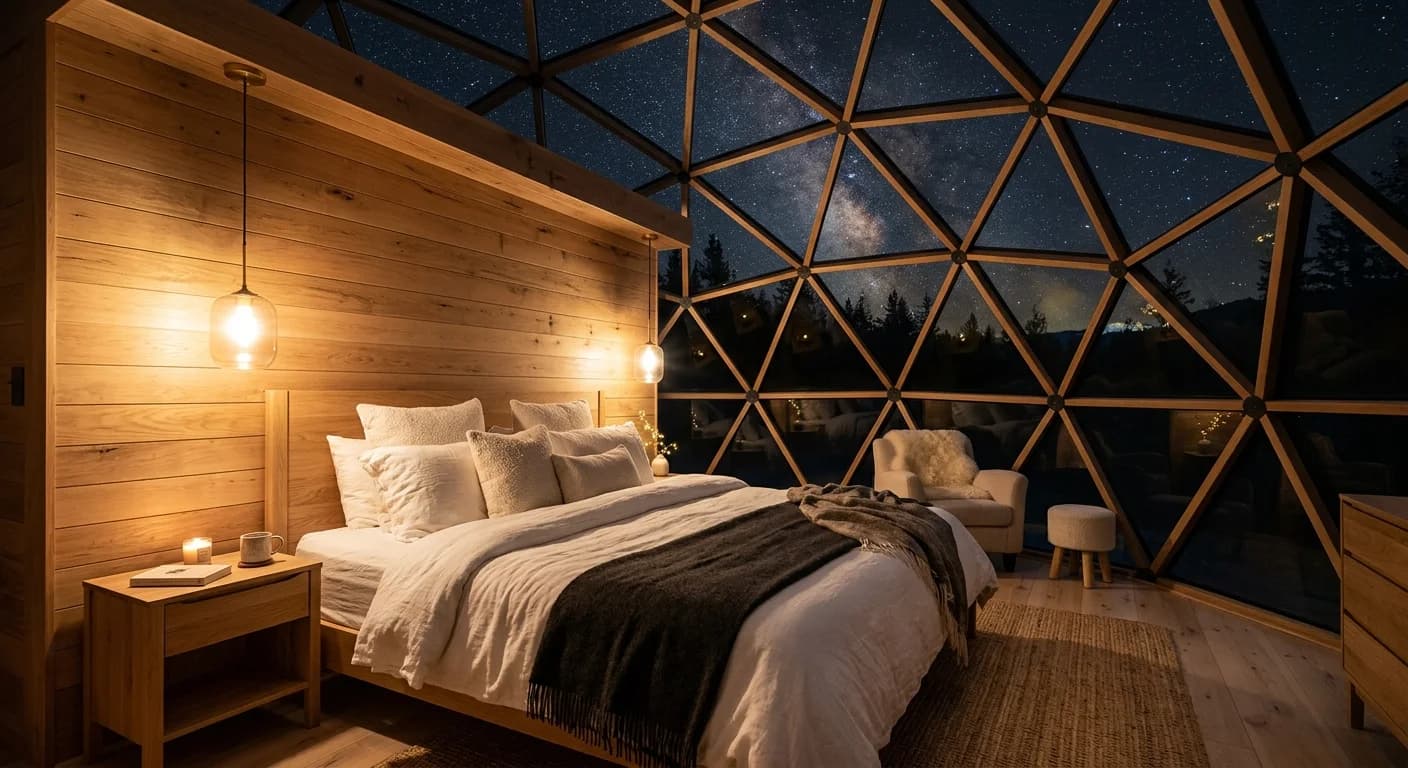
There's a particular quality to stargazing from inside a geodesic dome that's hard to replicate any other way. The transparent panels frame the sky like a planetarium, except everything you're seeing is real. You're warm, you're comfortable, and the sky fills your peripheral vision in a way that lying in a sleeping bag on the ground never quite achieves.
At LuxeDen Resorts, the geodesic domes sit on the Snake River south of Twin Falls in open rangeland — no trees blocking the horizon to the south where the Milky Way's core rises, no neighbors' porch lights wrecking your dark adaptation. The property's location along the river corridor benefits from the natural light-baffling effect of the canyon terrain, and the nearest significant light pollution is Twin Falls itself, shielded to the north.
The experience of watching the Milky Way rotate overhead from a heated dome, with the river audible in the background, is fundamentally different from the usual stargazing trip where you're fighting cold, dew, mosquitoes, and fatigue. You can fall asleep watching Orion set through the panels. You can wake at 3 AM, glance up without leaving the bed, and see Jupiter blazing in a sky you didn't have to drive anywhere to reach.
For astrophotography, the dome platforms provide a stable, level surface, and the absence of nearby light sources means you can run long exposures without stray light contamination. Bring a tripod and a camera with manual exposure capability — even a smartphone in night mode will capture the Milky Way from this location.
Best Time of Year
The best stargazing idaho conditions depend on what you're after, but the sweet spots are:
Peak Milky Way (June - September): The galactic core is visible, nights are warm enough to be comfortable outdoors, and Idaho's summer weather is reliably clear. July and August are prime months. The tradeoff is shorter nights — true astronomical darkness doesn't arrive until 10:30-11 PM in midsummer.
Best Seeing Conditions (October - February): Cold, dry air produces the sharpest, most transparent skies. Winter is ideal for planetary observation, double stars, and deep-sky objects that benefit from steady seeing. Nights are long — 14+ hours of darkness in December — giving you ample observing time. The tradeoff is cold temperatures, though staying in a heated dome eliminates this entirely.
Meteor Showers: The Perseids (August 11-13), Geminids (December 13-15), and Quadrantids (January 3-4) are the three strongest annual showers. Plan around the moon phase — a full moon washes out all but the brightest meteors.
Moon Phase Matters More Than Season: Whatever time of year you visit, check the lunar calendar. The week centered on new moon offers the darkest skies. Even a quarter moon significantly brightens the sky and reduces the number of visible stars. Plan your trip around the new moon and you'll see dramatically more.
Equipment and Apps
You don't need a telescope to have a remarkable stargazing experience from a dark Idaho site. Your eyes are the best wide-field instrument you own, and from Bortle 2 skies, they'll show you more than you expect.
Essential:
- Red flashlight or headlamp — White light destroys dark adaptation, which takes 20-30 minutes to develop. A red LED preserves it. Most headlamps have a red mode; use it exclusively.
- Star chart or app — Stellarium (free, available on desktop and mobile) is the gold standard. SkySafari is excellent on mobile. Both let you hold your phone to the sky and identify what you're looking at in real time. Keep your screen brightness at minimum and use night mode (red overlay).
- Binoculars — A pair of 7x50 or 10x50 binoculars transforms the night sky. They'll reveal the Andromeda Galaxy's shape, resolve star clusters the Pleiades into individual stars with halos, show Jupiter's moons, and reveal hundreds of stars invisible to the naked eye. No telescope needed.
Nice to Have:
- Camera with manual mode — Any camera that can shoot 15-30 second exposures at ISO 1600-3200 will capture the Milky Way. Use a tripod and a 2-second timer or remote shutter. Even modern smartphones with night mode produce surprisingly good results from dark sites.
- Green laser pointer — Useful for pointing out specific stars and constellations to others. Use responsibly — never shine toward aircraft or other people.
- Warm layers — Even in summer, Idaho nights at elevation can drop into the 40s. Dress warmer than you think you'll need.
Apps Worth Installing:
- Stellarium Mobile — The most accurate planetarium app available. Free version is excellent.
- Clear Outside — Forecasts cloud cover, seeing, and transparency specifically for astronomers. Check it the afternoon before your stargazing session.
- Light Pollution Map — Lets you check the Bortle class of any location. Useful for planning where to drive if you want to find the darkest nearby spot.
- Moon Phase Calendar — Any basic moon phase app helps you plan around the lunar cycle.
Where to Stay for Dark Sky Access
How you approach dark sky lodging in Idaho depends on what kind of experience you want.
Central Idaho Dark Sky Reserve (Stanley area): Several lodges and idaho dark sky reserve cabins in and around Stanley put you at the heart of the reserve. Options range from rustic Forest Service cabins to modern lodges. The town is small and seasonal — most accommodations book out for peak summer months well in advance. You'll be at Bortle 1-2 but roughly 2.5 hours from Twin Falls and 3 hours from Boise.
Sun Valley / Ketchum: More amenities and dining than Stanley, with access to good dark sky sites within a 20-30 minute drive. Not as dark as Stanley itself due to resort lighting, but a reasonable compromise between comfort and sky quality. About 90 minutes from Twin Falls.
Twin Falls area: Twin Falls itself is too bright for serious stargazing, but the surrounding Magic Valley is excellent. The key is staying somewhere that's already outside the light dome — which eliminates the "drive 45 minutes in the dark to your observing site, then drive 45 minutes back" pattern that makes most dark sky trips exhausting.
LuxeDen Resorts sits in that sweet spot: close enough to Twin Falls for convenient access to restaurants, groceries, and Shoshone Falls, but far enough south along the river to be outside the city's light footprint. The geodesic domes face open sky in every direction, and the dark sky is part of the nightly experience rather than something you have to go find. You're at Bortle 2-3 from your bed.
For anyone planning a dark sky trip to southern Idaho, the combination of Twin Falls daytime activities with dark sky lodging outside the city is the most practical approach. You get the waterfalls, the canyon, the restaurants, and the river during the day — and a sky full of stars the moment the sun goes down.
Keep Exploring
- Stargazing from a Geodesic Dome
- Geodesic Dome Glamping: The Complete Guide
- Outdoor Adventures Near Twin Falls
- Glamping in Idaho: The Complete Guide
- 3-Day Idaho Vacation Itinerary
The Milky Way doesn't require a reservation, but the best seats under it go fast. If dark sky Idaho is on your list, start with the moon calendar, pick a new moon weekend, and book a dome. Everything else — the stars, the planets, the meteors — will take care of itself.