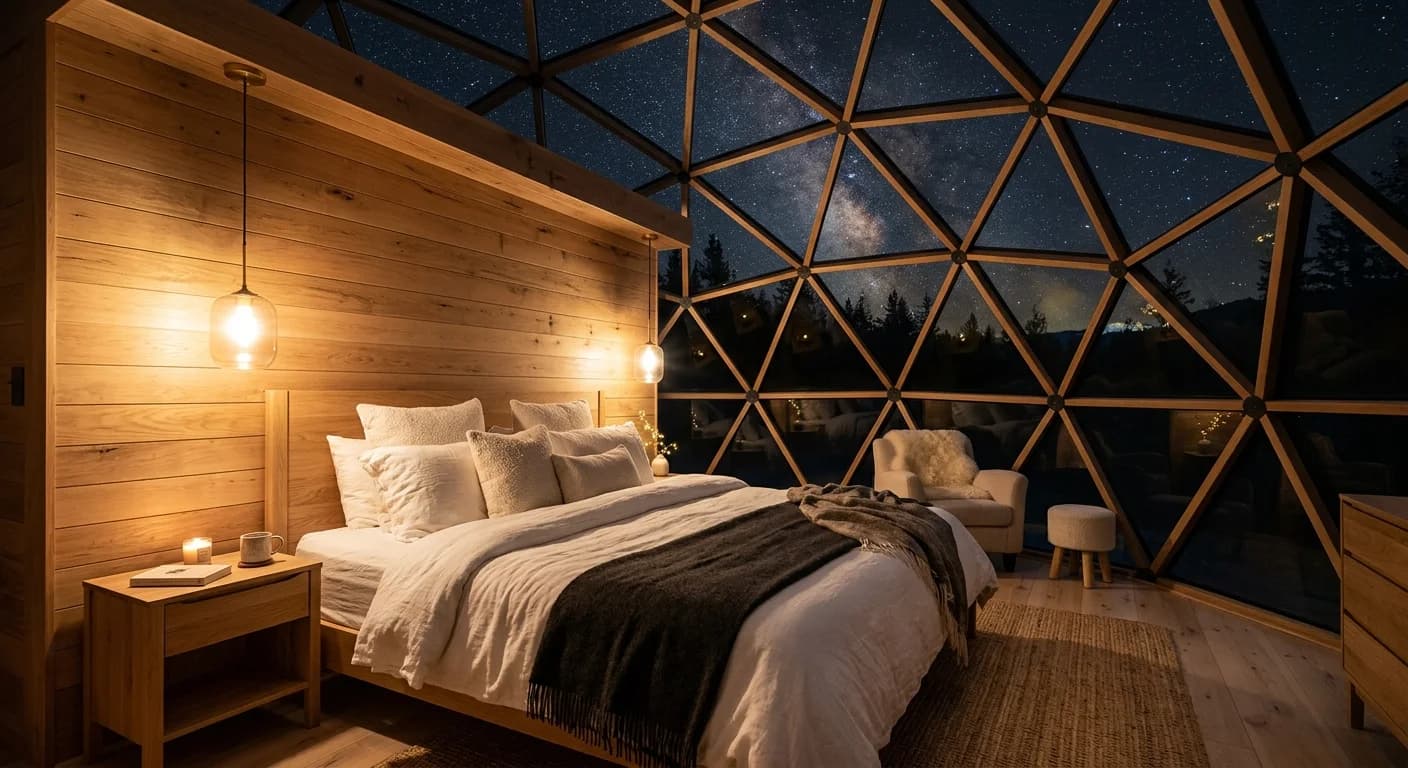
Most people who say they love stargazing have never done it properly. They have spent fifteen minutes craning their neck in a backyard, gotten cold, and gone inside. The problem is not lack of interest. The problem is that traditional stargazing is physically uncomfortable enough to cut every session short.
Geodesic domes with transparent ceiling panels solve this completely. You lie in a warm bed, look straight up, and the sky fills your entire field of vision for as long as you want to watch. It is the difference between glimpsing the night sky and actually living under it.
The Problem with Traditional Stargazing
Stargazing has a comfort problem that nobody talks about honestly.
You drive somewhere dark. You set up a blanket or a chair. You tilt your head back. Within minutes, your neck hurts. Within twenty minutes, you are cold. If you brought a telescope, you are hunched over an eyepiece in an awkward position. The entire experience is a negotiation between wanting to keep looking and wanting to stop being uncomfortable.
This is why most stargazing sessions last under thirty minutes. Not because people lose interest in the Milky Way -- the Milky Way is genuinely astonishing -- but because lying on frozen ground or sitting in a camp chair with your head cranked backward has a hard physical limit.
There are other problems too. Dew settles on everything. Mosquitoes find you. If you brought binoculars, your arms get tired holding them overhead. If it is winter and the seeing is best, you are layered in so many clothes that adjusting equipment becomes clumsy. If you finally get warm inside a sleeping bag, you cannot move to look at different parts of the sky without unwrapping yourself.
The result is that most people experience the night sky in brief, uncomfortable glimpses rather than the sustained, relaxed observation that actually reveals what is up there.
How Geodesic Domes Change the Experience
A geodesic dome with transparent ceiling panels inverts every part of the traditional stargazing equation.
You are warm. The dome is climate-controlled. In winter, the heating system keeps the interior comfortable while temperatures outside drop below freezing. You are in a bed with real blankets, not a sleeping bag on the ground.
You are lying down. The transparent panels are overhead, which means the natural viewing position is flat on your back. No neck strain. No awkward angles. The position you would choose if comfort were the only consideration happens to be the optimal position for looking at the sky through a dome ceiling.
You can watch all night. Because there is no discomfort to push you toward quitting, sessions extend naturally. People who normally stargaze for twenty minutes find themselves watching for two or three hours, drifting in and out of sleep, waking to a different sky each time. This is when stargazing goes from novelty to something genuinely meditative.
The view is panoramic. A geodesic dome's curved structure means transparent panels can cover a wide arc of the ceiling, often 180 degrees or more of sky visible from the bed. This is vastly more sky than you see through a telescope eyepiece or even lying flat outdoors, where trees, hills, and horizon obstructions cut into the view.
There is no setup. No driving to a dark site. No assembling equipment. No waiting for your eyes to adjust while fumbling with a red flashlight. You turn off the interior lights, and the sky is there. The transition from daily life to stargazing takes about thirty seconds.
What You Can See Through a Dome Ceiling
The concern people raise first: can you actually see stars through glass? The answer depends entirely on two factors -- the quality of the panels and the darkness of the location. In a well-designed dome in a dark sky area, you can see dramatically more than most people have ever seen.
The Milky Way
The band of our galaxy is visible from any sufficiently dark location, dome or no dome. Through quality transparent panels, it appears as a textured river of light stretching across the overhead view. The difference in a dome is duration. You can watch it rotate slowly across the sky over hours, tracking its movement in a way that makes the Earth's rotation viscerally real.
Meteor Showers
Dome ceilings are arguably better for meteor showers than open-air viewing. Meteors appear across the entire sky unpredictably, and the wide-angle overhead view through a dome ceiling lets you catch more of them without constantly repositioning. During peak showers like the Perseids (August) or Geminids (December), rates can exceed one meteor per minute -- lying in bed watching them streak across the panels overhead is an experience that sticks with people.
Planets and the Moon
Bright objects like Jupiter, Venus, Saturn, and the Moon are easily visible through dome panels. You will not get telescope-level detail of Saturn's rings, but you will see planets as distinctly bright points that do not twinkle the way stars do. The Moon through transparent panels is striking -- bright enough to cast shadows inside the dome.
Satellites and the ISS
The International Space Station crosses overhead regularly, appearing as a bright, steadily moving point of light. Satellites trace slower arcs. From a dome bed, you catch these almost accidentally -- a bright dot sliding across your peripheral vision while you are watching something else.
Deep Sky Objects
With fully dark-adapted eyes (which happens naturally when you have been lying in a dark dome for thirty minutes or more), you can spot the Andromeda Galaxy as a faint smudge, the Pleiades star cluster as a tight grouping, and Orion's Nebula as a hazy patch below Orion's belt. These are subtle, but they are there -- and the relaxed viewing position makes the patience required feel effortless.
The Experience, Hour by Hour
Dome stargazing has a rhythm that unfolds differently than you might expect.
Dusk to 10 PM
The first stars appear while there is still color in the western sky. Through the dome panels, you watch the transition from blue to deep indigo. The brightest stars and planets emerge first -- Venus near the horizon, Jupiter overhead, maybe Mars with its faint orange tint. This is the social hour. You are still awake, maybe having a drink, pointing things out. The sky is interesting but not yet overwhelming.
10 PM to Midnight
Full darkness arrives and the sky transforms. The Milky Way becomes visible if you are in a dark enough location. Star density increases dramatically -- what looked like empty space between bright stars fills in with thousands of dimmer ones. This is usually when people go quiet. The scale of what you are looking at starts to register. The dome panels frame it overhead like a planetarium, except everything is real and slowly rotating.
Midnight to 2 AM
The deepest dark. Light pollution from distant towns drops as businesses close and streetlights cycle off. If you are still awake, this is peak viewing. Your eyes are fully adapted. The Milky Way has texture and structure. You start noticing color differences between stars -- blue-white Vega, orange Arcturus, red Betelgeuse. The silence and the scale combine into something that feels significant in a way that is hard to articulate.
2 AM to Dawn
Most people fall asleep and wake intermittently. Each time you open your eyes, the sky has shifted. Constellations that were overhead are now near the edge of the panels. New ones have risen from the east. If you wake around 4 AM, you might catch the zodiacal light -- a faint triangular glow along the ecliptic -- or early-rising planets that were not visible at bedtime. Dawn creeps in slowly, washing out the stars in reverse order of brightness.
Dome Design Details That Matter
Not all transparent dome panels deliver the same stargazing experience. Several design choices make a significant difference.
Panel Material
Polycarbonate panels are the most common choice for geodesic dome glazing. Multi-wall polycarbonate offers good insulation and decent optical clarity, though it can create a slight haze compared to glass. Single-wall polycarbonate is optically clearer but insulates less.
Tempered glass panels provide the best optical clarity -- stars appear sharper and brighter. The tradeoff is weight (requiring stronger framing) and cost. For dedicated stargazing domes, the visual improvement is worth it.
ETFE film (ethylene tetrafluoroethylene) is used in some modern dome designs. It is lightweight, highly transparent, and self-cleaning. Optical quality is excellent, though it can produce slight distortion in strong wind.
Panel Placement and Coverage
The ideal stargazing dome has transparent panels concentrated on the upper hemisphere -- roughly the top 60 percent of the dome surface. Lower panels can be opaque or translucent for privacy. The bed should be positioned so that lying flat puts the densest concentration of transparent panels directly overhead.
Orientation
Dome orientation matters more than most people realize. In the Northern Hemisphere, a dome with its primary transparent section facing south captures the richest part of the sky, where the ecliptic (the path of planets, Moon, and Sun) and the densest Milky Way sections arc across. North-facing transparency captures circumpolar constellations and star trails around Polaris.
Light Control
Interior light management is critical. Even small indicator lights on electronics can wreck dark adaptation. The best stargazing domes use blackout coverings for any interior LEDs, red-light-only options for nighttime navigation, and exterior shielding to block light from neighboring structures.
Photographing the Sky Through Glass
Astrophotography through dome panels is possible but comes with trade-offs worth understanding before you arrive with expectations and a tripod.
What Works
Wide-angle shots of the sky through the dome create stunning images that capture both the interior and the stars. These "dome under the stars" compositions are unique to this type of accommodation and make compelling photographs. A wide-angle lens at f/2.8 or wider, ISO 3200-6400, and a 15-25 second exposure will capture the scene.
Time-lapses work well. Set a camera on a tripod inside the dome, pointed up through the panels, and shoot one frame every 30 seconds. The resulting video shows stars wheeling overhead through the geometric frame of the dome structure -- visually striking.
Phone photography has improved enough that modern smartphones in night mode can capture the Milky Way through dome panels, though results vary. Worth trying; do not count on it.
Limitations
Reflections are the main challenge. Any light inside the dome -- a phone screen, an alarm clock, a charging indicator -- reflects off the interior panel surface and appears in photographs. Eliminating all interior light sources is essential.
Panel artifacts can appear in long exposures. Scratches, condensation, or dust on panels show up as smudges or streaks. Panels that look perfectly clear to the eye may reveal imperfections in a 30-second exposure.
Condensation can form on interior panel surfaces in cold weather, especially in domes without adequate ventilation. This creates a diffused, foggy effect that ruins sharp star images but can occasionally produce atmospheric shots by accident.
Practical Tips
- Bring a small tripod or gorilla pod that you can position on the bed or a side table
- Turn off every light source in the dome, including phone notifications
- Shoot through the center of panels rather than near frame edges where distortion increases
- If condensation forms, a microfiber cloth and patience can clear a panel temporarily
- Use a remote shutter or timer to avoid camera shake
Where Dome Stargazing Works Best
Location determines ninety percent of the stargazing quality. The best dome in the world delivers nothing impressive if it sits under light-polluted skies.
Dark Sky Areas
The International Dark-Sky Association designates parks, reserves, and communities that maintain exceptional nighttime darkness. Domes located in or near these areas offer the best stargazing experiences. Bortle Scale ratings of 1-3 (the darkest categories) mean the Milky Way casts visible shadows and thousands of stars are visible to the naked eye.
High Elevation and Dry Climate
Higher altitude means less atmosphere between you and the stars, which means less atmospheric distortion and scattering. Dry climates have fewer clouds and less moisture in the air, both of which improve transparency. The American West -- particularly Idaho, Utah, Nevada, and Arizona -- combines elevation, aridity, and sparse population density into ideal conditions.
Idaho Specifically
Southern Idaho offers some of the darkest skies in the contiguous United States. The population density is low, cities are small and widely spaced, and the high desert elevation (typically 3,000-5,000 feet) provides excellent atmospheric conditions. The Snake River Plain creates a natural corridor of darkness between mountain ranges.
Craters of the Moon National Monument is a designated Dark Sky Park, and the surrounding region benefits from the same conditions. The Twin Falls area sits at the edge of this dark sky corridor, with minimal light pollution to the south and east. On clear nights, the Milky Way is visible as a structural feature of the sky -- not a faint suggestion, but a bright, detailed band with visible dark lanes and star clouds.
The climate cooperates too. Southern Idaho averages over 200 clear nights per year, with the driest and clearest conditions in late summer and early fall -- exactly when the Milky Way's galactic center is positioned for optimal viewing.
Compared to Other Stargazing Accommodations
Dome glamping is not the only way to combine stargazing with overnight accommodation. Here is how the alternatives compare.
Bubble Hotels
Transparent inflatable bubbles offer a similar concept -- sleeping under the stars. The visual experience is comparable, but bubbles have practical drawbacks. They are noisy (the inflation fan runs continuously), offer less insulation (cold in winter, hot in direct sun), and feel less structurally substantial. Geodesic domes are quieter, better insulated, and feel more like a permanent structure because they are one.
Observatory Stays
Some observatories and astronomical lodges offer overnight programs with telescope access. These provide far superior magnified viewing -- you will see Saturn's rings, Jupiter's moons, and deep sky objects in detail impossible with the naked eye. However, you are still standing at an eyepiece in a cold observatory, not lying in bed. The experience is educational and impressive but not relaxing. Observatory visits and dome stays complement each other rather than compete.
Open-Air Camping
Sleeping outdoors under the stars is the original version of this experience. The sky view is unobstructed, which is the one clear advantage. Every other factor favors the dome: warmth, comfort, insect protection, wind protection, and the ability to watch all night without physical discomfort. Most people who try dome stargazing after years of open-air camping describe it as the experience they were always trying to have.
Skylight Hotels
Some hotels install large skylights or glass ceilings for stargazing. These work if the hotel is in a dark location, but most are in developed areas where light pollution limits the view. The glass quality and coverage area are typically inferior to purpose-built dome panels. It is a nice feature in a hotel room but not a stargazing destination.
Glass Igloos
Popular in Scandinavia, glass igloos offer thermal glass panels for viewing the Northern Lights and stars. The concept is nearly identical to dome stargazing, and the best glass igloo experiences are excellent. The main limitation is geographic -- they are concentrated in Arctic regions, which means very short winter nights (best for aurora) and very long summer nights (not ideal for stars).
Why This Changes How You Think About the Night Sky
There is a reason people describe dome stargazing in emotional terms rather than technical ones. The experience shifts something.
Part of it is duration. When you watch the sky for three hours instead of twenty minutes, you stop seeing it as a static backdrop and start perceiving it as a moving system. Stars drift. Constellations rotate. Planets hold their positions while everything else wheels around them. The sky becomes a clock, a calendar, a mechanism.
Part of it is comfort. When your body is warm and relaxed, your mind follows. The anxious checking of "how much longer can I stay out here" disappears. You settle in. Thoughts slow down. The scale of what you are looking at has room to register without competing with physical discomfort.
And part of it is the dome itself. The geometric framework of the panels creates a structure around the view -- a frame that somehow makes the infinity of the sky more approachable. You are not exposed to it. You are sheltered while observing it. That combination of safety and vastness does something to people that is hard to manufacture any other way.
The night sky has not changed. Humans have just spent the last century making it increasingly difficult to see. A geodesic dome in a dark sky location does not add anything to the experience. It removes every barrier that was in the way.
Keep Reading
- Stargazing and Dark Sky Guide for Idaho -- The best dark sky locations, seasonal calendars, and astronomical events across Idaho.
- Complete Guide to Geodesic Dome Glamping -- Everything about dome stays, from design to booking.
- Geodesic Dome Glamping Prices Guide -- What dome stays cost and how to find the best deals.
- 3-Day Idaho Vacation Itinerary -- Plan a full Twin Falls trip with stargazing built in.