When most people think about glamping in the American West, Utah dominates the conversation. Moab, Zion, Bryce Canyon — these names carry weight, and for good reason. Utah's red rock landscapes are genuinely spectacular, and the glamping scene there has exploded over the past decade.
But there is a problem. Everyone else has noticed too.
Southern Idaho sits just a few hours north, offering a dramatically different landscape with darker skies, thinner crowds, and nightly rates that won't require a second mortgage. It is not better than Utah in every category — but for a growing number of glampers, it is the smarter choice.
Here is an honest, side-by-side look at both states so you can decide for yourself.
The Utah Glamping Scene
Utah has earned its reputation. The concentration of national parks — Zion, Bryce Canyon, Arches, Canyonlands, Capitol Reef — gives it an unmatched density of iconic terrain. The glamping industry has responded with hundreds of properties, from luxury tent camps outside Moab to dome resorts near Zion.
The most popular areas include:
Moab: Gateway to Arches and Canyonlands. Red rock desert, mountain biking mecca, and the most saturated glamping market in the state. Properties like Under Canvas and AutoCamp have turned it into a household name for outdoor hospitality.
Zion corridor (Springdale to Hurricane): The southern Utah stretch draws millions of park visitors annually. Glamping spots here range from basic safari tents to high-end yurts. Availability during peak season (March through October) requires booking months ahead.
Bryce Canyon area: Less crowded than Zion or Moab but growing fast. The canyon's hoodoo formations are unlike anything else on the continent. Properties here tend to be smaller and more intimate.
Park City and the Wasatch Range: Northern Utah's mountain glamping caters to a different crowd — ski-season visitors and summer hikers. More alpine forest than desert, with prices reflecting the resort-town proximity.
Utah's glamping infrastructure is mature. Reviews are plentiful, road access is good, and you know what you are getting. That maturity, however, comes with trade-offs.
What Southern Idaho Offers
Southern Idaho's high desert is a different world. Instead of red sandstone, you get volcanic basalt canyons carved by the Snake River. Instead of national park crowds, you get open rangeland and agricultural communities where tourism is not the primary economy.
The Twin Falls region sits at the center of this landscape. Within a short drive, you have:
Shoshone Falls: Taller than Niagara Falls at 212 feet, this waterfall on the Snake River is the anchor attraction of the region. Spring runoff (April through June) produces the most dramatic flows.
Snake River Canyon: The 500-foot basalt canyon that bisects Twin Falls creates a natural amphitheater. The Perrine Bridge spans it at 486 feet, making it one of the only bridges in the U.S. where BASE jumping is legal year-round.
Thousand Springs: A series of waterfalls and springs erupting from the canyon walls along a stretch of the Snake River. The geology here — water from the Lost River Range traveling underground for decades before surfacing — is genuinely unique.
Bruneau Dunes: The tallest single-structured sand dune in North America, rising 470 feet. The adjacent observatory offers public stargazing programs.
Craters of the Moon: A volcanic landscape that looks like it belongs on another planet. Lava flows, cinder cones, and lava tubes spread across 750,000 acres.
This is not a place that needs to be discovered — it needs to be reconsidered. The attractions are world-class. They just do not have the marketing budgets of Utah's national parks.
Side-by-Side Comparison
Before diving into specifics, here is the high-level picture:
| Factor | Utah | Southern Idaho | |--------|------|----------------| | Average nightly rate (dome/luxury tent) | $250-$450 | $150-$300 | | Peak season availability | Book 3-6 months ahead | Book 2-4 weeks ahead | | Bortle scale (dark sky quality) | 3-5 (varies by location) | 1-2 (exceptional) | | Annual visitors to top attractions | 4-5 million (Zion alone) | ~300,000 (Shoshone Falls) | | Nearest commercial airport | SLC (4-5 hrs to southern UT) | Twin Falls (15 min) or Boise (2 hrs) | | Summer high temperatures | 95-105F (southern UT) | 85-95F | | Glamping property density | High (hundreds of options) | Low (emerging market) | | Natural attraction diversity | Red rock, canyons, alpine | Volcanic, canyon, desert, springs |
These numbers tell a clear story. Utah wins on variety of properties and brand recognition. Idaho wins on price, accessibility, dark skies, and elbow room.
Dark Skies: The Biggest Gap
This is where the comparison gets lopsided. Southern Idaho's dark sky quality is in a different league.
The Bortle scale measures night sky darkness from 1 (pristine) to 9 (inner-city). Most of southern Idaho, particularly the areas south and east of Twin Falls, registers at Bortle 1-2. That means you can see the Milky Way's structure with the naked eye, satellites are easily tracked, and the zodiacal light is visible on the horizon.
Utah's popular glamping areas tell a different story. Moab sits at Bortle 3-4 due to the town's growth and light pollution from nearby developments. The Zion corridor is Bortle 4-5. Even Bryce Canyon, which has an official Dark Sky designation, registers Bortle 2-3 — better than most of Utah, but still a step behind Idaho's remote high desert.
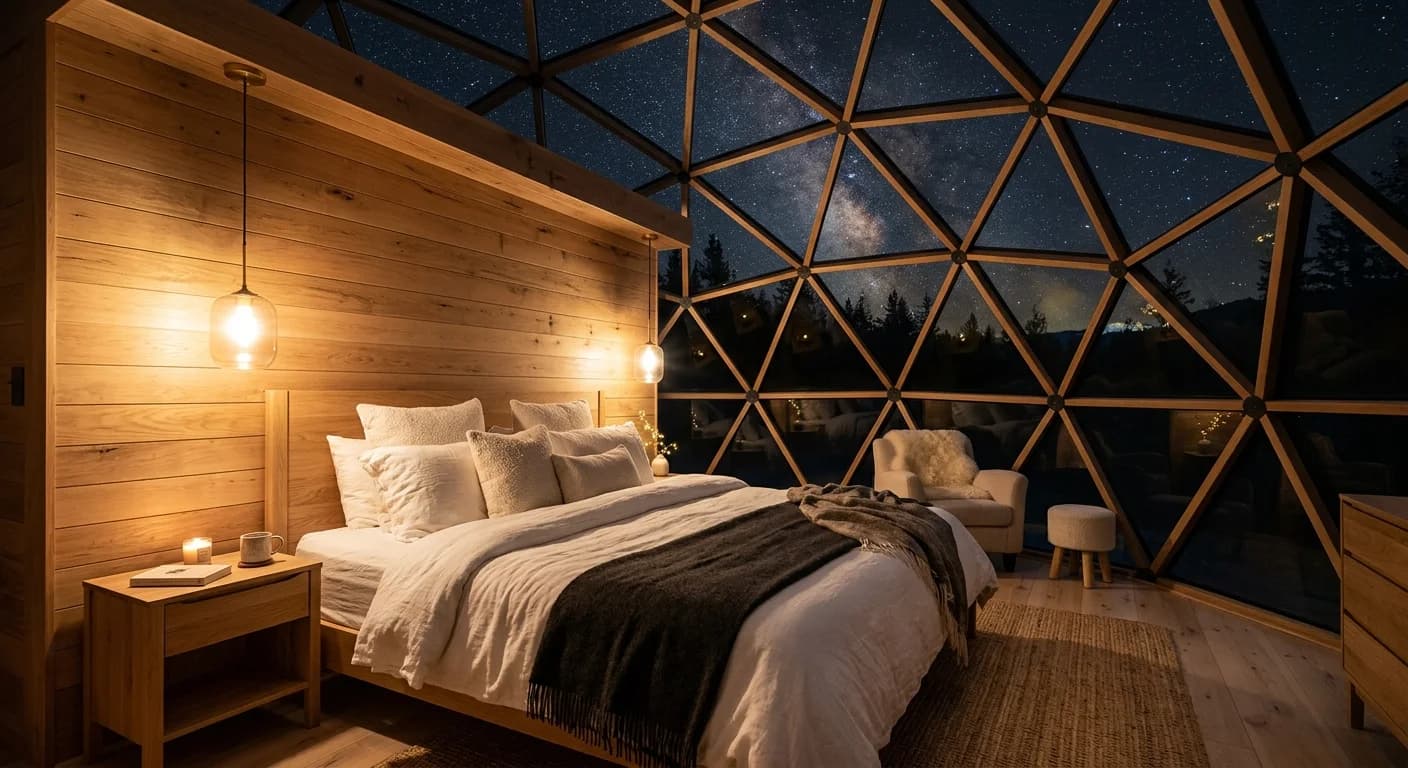
For stargazers, astrophotographers, or anyone who simply wants to lie in a geodesic dome and watch the sky without light pollution, southern Idaho is objectively superior. It is one of the darkest inhabited regions in the Lower 48.
The practical difference is significant. At Bortle 1-2, you are not just seeing stars — you are seeing the structure of the galaxy, meteor showers become events with dozens of visible trails per hour, and planets cast faint shadows on the ground. At Bortle 4-5, you see stars, but the sky lacks that dimensional depth.
Crowd Levels and Availability
Utah's success is also its challenge. Zion National Park recorded over 4.6 million visitors in recent years. Arches implemented a timed-entry reservation system because the parking lots were overflowing. The Angels Landing lottery now limits one of the park's most famous hikes to a fraction of the people who want to do it.
This pressure radiates outward to glamping properties. Popular Moab domes and luxury tents sell out months in advance during spring and fall. Prices spike during peak weeks. The experience of "getting away from it all" can feel ironic when you are sharing a dirt road with forty other vehicles.
Southern Idaho operates at a fraction of that volume. Shoshone Falls, the region's most-visited attraction, sees roughly 300,000 visitors annually — about 6% of Zion's traffic. The Snake River Canyon rim trails are often empty on weekdays. Thousand Springs is a place you might have entirely to yourself on a Tuesday morning in May.
For glamping specifically, this means availability is rarely an issue outside of major holiday weekends. You can often book a dome or luxury tent two to four weeks out, even in peak summer. The experience of quiet isolation — which is supposed to be the entire point of glamping — is actually achievable here.
Pricing Reality Check
Glamping is not cheap anywhere, but the gap between Utah and Idaho is meaningful.
A high-end geodesic dome near Moab or Zion typically runs $300-$450 per night during peak season. Add in-demand weekends and you are looking at $400-$500. Budget-friendly options exist, but they sacrifice the "luxury" part of glamping — basic tents with shared bathrooms rather than private domes with full amenities.
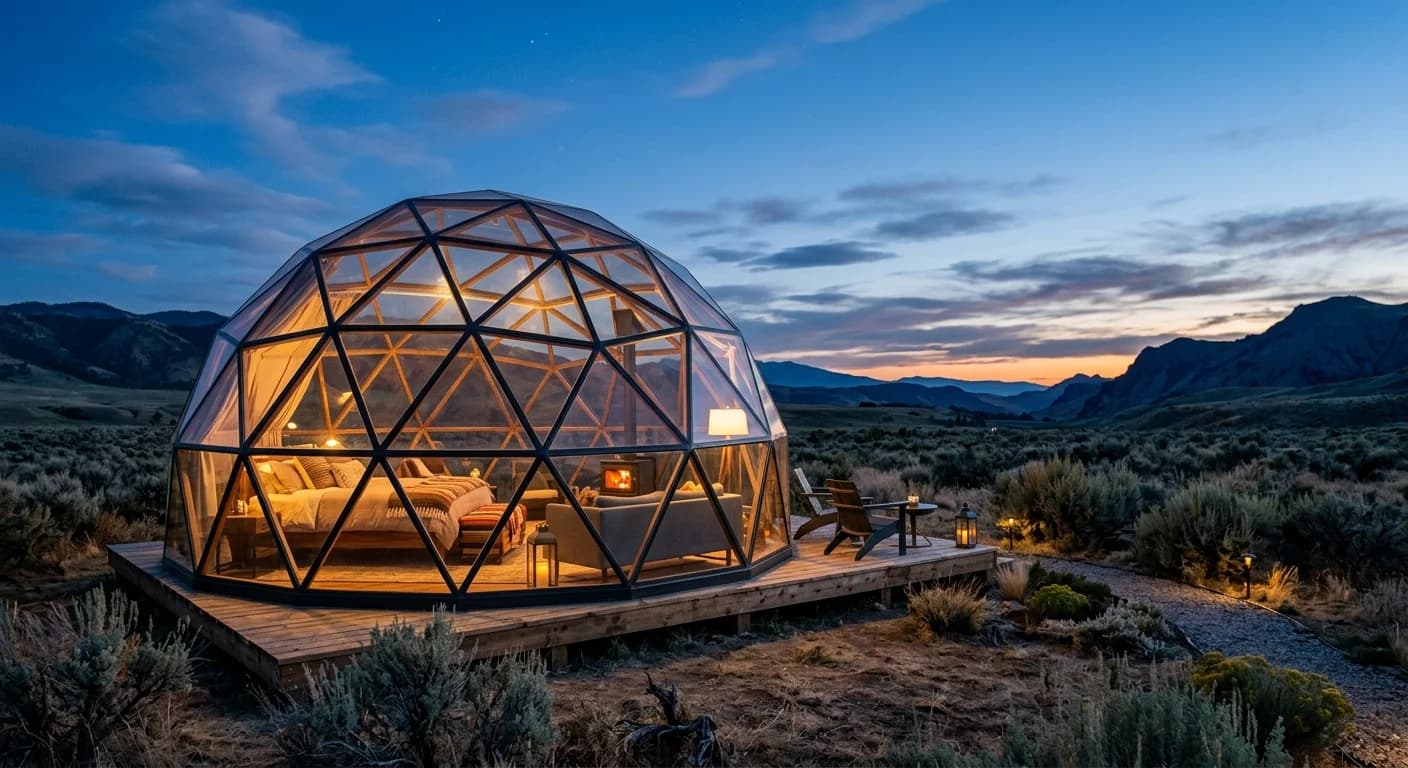
Southern Idaho's luxury glamping market is newer and less saturated. Comparable properties — geodesic domes with private bathrooms, climate control, and premium bedding — typically price between $150-$300 per night. The lower operating costs (land is cheaper, staffing is less competitive, and property taxes are lower) translate directly to guest pricing.
Over a three-night stay, the difference can easily reach $300-$600. That is money you could spend on experiences — a guided fishing trip on the Snake River, a Thousand Springs boat tour, or simply an extra night.
It is worth noting that Idaho's lower prices are not a reflection of lower quality. They reflect a less inflated market. The domes, the amenities, the landscapes — these are comparable. The pricing just has not been pushed upward by the same demand pressure that Utah faces.
Natural Attractions
Utah and Idaho offer fundamentally different geologies, and preference here is genuinely subjective.
Utah's strengths:
- Red rock formations with no equivalent anywhere on Earth
- Five national parks within a single state
- Slot canyons, natural bridges, and arches
- The otherworldly quality of landscapes like Bryce and Goblin Valley
- Established trail systems with excellent signage and maintenance
Southern Idaho's strengths:
- Volcanic terrain (lava fields, cinder cones, lava tubes at Craters of the Moon)
- River canyon ecology (waterfalls, hot springs, wildlife corridors)
- Agricultural beauty (rolling farmland meets dramatic basalt rimrock)
- Geological diversity within a small radius (dunes, canyons, lava, springs)
- Water features Utah lacks (Shoshone Falls, Thousand Springs, Snake River)
If your glamping trip is primarily about hiking through iconic red rock, Utah wins that category outright. Nothing in Idaho replicates the visual impact of The Narrows at Zion or sunrise at Mesa Arch.
But if you want variety — waterfalls one morning, lava tubes the next afternoon, sand dunes before sunset, and stargazing from a hot tub at night — southern Idaho packs a surprising amount of diversity into a compact region. Everything listed above sits within 90 minutes of Twin Falls.
Climate and Seasons
Southern Utah is a desert, and it acts like one. Summer temperatures in Moab and St. George regularly exceed 100F. The glamping season effectively compresses into spring (March-May) and fall (September-November) for comfortable outdoor conditions. Summer visits mean early-morning activity followed by sheltering from midday heat.
Southern Idaho's high desert sits at a higher elevation (around 3,700 feet for Twin Falls) with correspondingly lower temperatures. Summer highs run 85-95F — warm enough for outdoor swimming and comfortable enough for midday hikes. The shoulder seasons are cooler but extend the comfortable window further than Utah's southern properties.
Winter is where Idaho gets genuinely cold. Temperatures drop below freezing regularly from December through February, and snow is common. This is either a drawback or a feature, depending on whether you find the idea of watching snow fall from inside a heated dome appealing.
Utah's winter glamping is limited too, though the southern desert stays warmer than Idaho. The trade-off is that Utah's premium glamping season (spring and fall) coincides with its highest prices and lowest availability.
Accessibility and Getting There
Utah's geography creates a logistical challenge. The most popular glamping areas — Moab, Zion, Bryce — sit 4-5 hours from Salt Lake City, the nearest major airport. Las Vegas is closer to southern Utah (2.5 hours to Zion) but adds the cost and complexity of a hub airport.
Southern Idaho is more accessible than most people realize. Twin Falls has a regional airport (Joslin Field/Magic Valley Regional) with service to several hubs. Boise, the nearest major airport, is approximately two hours west via I-84. Salt Lake City sits about three hours south.
For road-trippers, Idaho sits on the I-84 corridor connecting Boise, Portland, and Salt Lake City. Twin Falls is a natural midpoint stop — a fact that has historically made it a pass-through town rather than a destination. That is changing.
The drive from the Boise airport to the Twin Falls area is straightforward interstate the entire way. Compare that to the winding two-lane roads approaching Zion or the remote highways to Moab, and Idaho's practical accessibility stands out — particularly for travelers with kids, towing trailers, or arriving late at night.
Who Each State Is Best For
Choose Utah glamping if you:
- Specifically want red rock desert landscapes
- Are checking national parks off a bucket list
- Prefer a mature hospitality market with abundant reviews and options
- Want established trail systems with ranger programs
- Do not mind crowds and are willing to book far in advance
- Have a flexible budget
Choose southern Idaho glamping if you:
- Prioritize dark sky stargazing
- Want genuine quiet and fewer people
- Are traveling on a tighter budget without sacrificing quality
- Prefer geographic diversity (water, lava, desert, canyon) in a compact area
- Value accessibility from airports and interstates
- Are looking for something most of your friends have not done yet
Honest Pros and Cons
Utah
Pros:
- Unrivaled red rock scenery — nothing on the planet compares
- Massive selection of glamping properties at every price point
- Five national parks with world-class trail systems
- Strong tourism infrastructure (restaurants, guides, gear shops)
- Year-round options in the southern desert corridor
Cons:
- Peak-season pricing has outpaced the value proposition for many travelers
- Crowds at major trailheads can feel oppressive
- Availability requires planning months in advance
- Light pollution has increased as gateway towns have grown
- The "off-the-grid" feeling is hard to find near popular parks
- Summer heat in southern Utah limits comfortable activity hours
Southern Idaho
Pros:
- Exceptional dark skies — Bortle 1-2 across wide areas
- Dramatically lower prices for comparable accommodations
- Genuine solitude is easy to find, even in peak summer
- Diverse natural attractions within a short drive
- Better airport and interstate accessibility than most Utah destinations
- Cooler summer temperatures at elevation
Cons:
- Fewer glamping property options (the market is still developing)
- No national parks — state parks and national monuments are the anchors
- Less established tourism infrastructure in some areas
- Cold winters limit the comfortable glamping season
- Fewer restaurant and nightlife options near properties
- Landscape lacks the visual drama of Utah's red rock formations
The Bottom Line
Utah earned its glamping reputation. The scenery is extraordinary, and the experiences are genuinely world-class. If seeing Zion or Arches is the point of your trip, go to Utah. No amount of value comparison changes what those places offer.
But if glamping itself is the point — the dark skies, the quiet, the disconnection from routine, the feeling of being somewhere wild — southern Idaho delivers that experience more reliably and more affordably than Utah does right now. The crowds that make Utah's parks famous are the same crowds that erode the solitude glamping is supposed to provide.
Southern Idaho is not trying to be Utah. It is offering something Utah used to be: uncrowded, affordable, and full of natural wonders that do not require a reservation lottery to enjoy.
The smart money is on Idaho. But do not take our word for it — come see for yourself before everyone else catches on.
Explore Idaho Glamping
- Glamping in Idaho: The Complete Guide — everything you need to know about glamping in the Gem State
- Geodesic Dome Glamping: What to Expect — the dome experience explained
- Romantic Glamping Getaways in Idaho — couples-focused guide with activity ideas
- Stargazing and Dark Skies in Idaho — why Idaho's Bortle 1-2 skies are in a different league
- Glamping vs Camping: What to Expect — not sure if glamping is for you? Start here